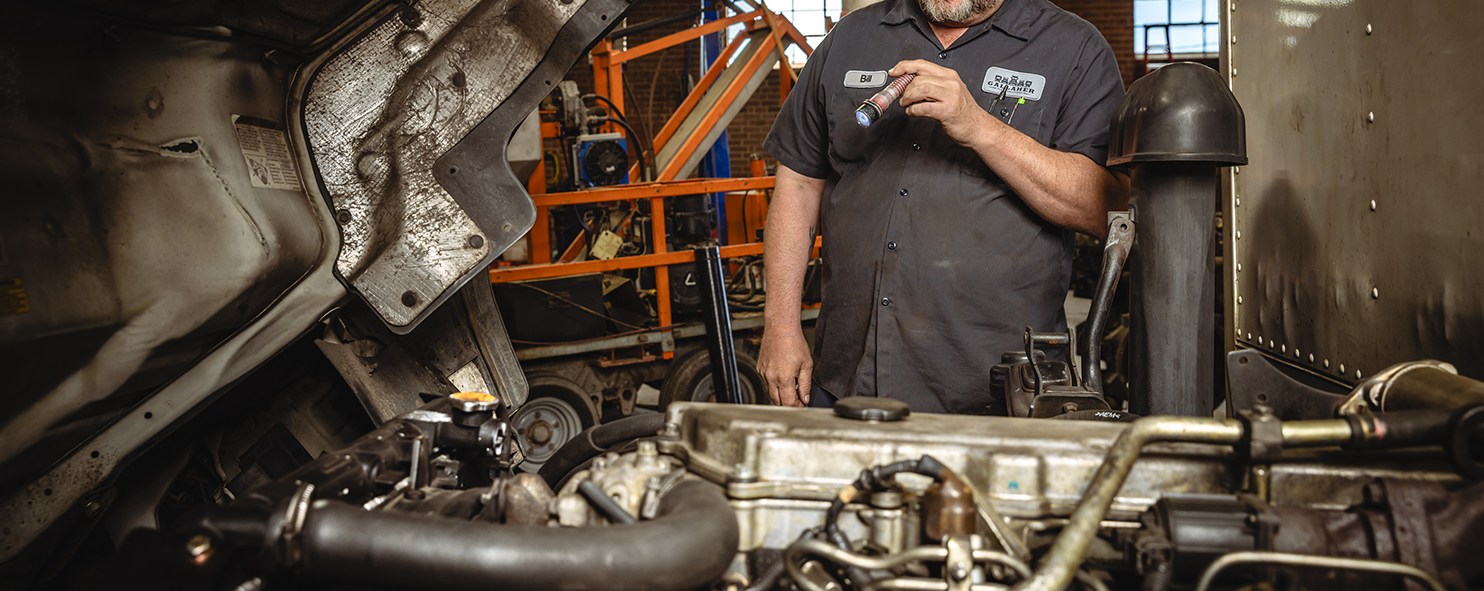
Commercial vehicles with a gross vehicle weight in excess of 26,000 pounds are required to have regular DOT inspections. Schedule your DOT inspection today with the team at Gallaher Fleet Solutions.
The U.S. Department of Transportation (DOT) takes the lead on ensuring that all commercial motor vehicles (CMVs) are safe by performing regular inspections. Their team checks all parts to make sure everything works correctly and safely. Most truck drivers are familiar with fleet DOT inspections, but do you understand the details of each inspection level? What about the most common DOT violations to avoid?
Each state oversees its own DOT inspections, usually conducted by state groups in collaboration:
A state trooper can perform an inspection anytime, anywhere. They may occur on the side of the road, at weigh stations, or at truck stops. Drivers are expected to act professionally and respectfully, understanding that law requires these inspections.
Finding no violations is the most desired outcome. If a driver doesn't have violations, they receive a CVSA decal that is good for three months. This lets other inspecting officers know that a CMV passed inspection recently.
Some violations are not serious. The driver can still perform their job, but they do not pass inspection and are expected to fix any violations within 15 days. These may also count against Compliance, Safety, Accountability (CSA) scores for both the driver and the carrier. If a driver receives an out-of-service (OOS) violation, they cannot drive again until all violations are addressed and documented properly.
Call the shop nearest you, or send a message and we'll get back to you the same business day.
An out-of-service (OOS) violation keeps a driver off the road until every issue is addressed and documented properly. These are the violations inspectors flag most often.
The CVSA defines six levels of commercial motor vehicle inspection. Here's what an officer checks at each one.
The most common and most thorough inspection. The officer looks at the tractor and trailer, including the battery, brakes, cargo securement, lights and tires. They also talk to the driver and look for signs of drug use or intoxication, required documents, and seat belt use. Any violations may result in a driver being taken out of commission for driving.
Level Two is less rigorous: the officer won't go underneath the truck but checks everything else. Level Three has no vehicle inspection — the officer reviews the driver's license, Driver Vehicle Inspection Report (DVIR), electronic logging device (ELD), Hours of Service (HOS) and Record of Duty Status (RODS).
Level Four is rare — officers usually complete a single-item inspection as a type of research. Level Five is the counterpart to a driver-only inspection: it happens at a carrier during compliance reviews, and the driver is not present.
If a driver is hauling dangerous or hazardous freight, this inspection looks at conditions unique to those shipments. Drivers must meet specific handling procedures and advanced out-of-service conditions.
DOT inspections are mandatory safety examinations of your vehicles, drivers and documentation. Our guide breaks down the most common inspection levels — from the comprehensive Level I to driver-focused Level III checks — and shows how regular maintenance, driver training and organized paperwork help your fleet prepare and avoid costly violations. Read the article →
